Nominal Pressure Class of Pressure Plastic Pipes – PN
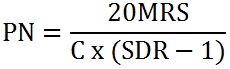
The PN of a plastic pipe is determined from the minimum required strength MRS (minimum required strength) of the pipe material, the design coefficient (or safety factor) and the standard dimension ratio SDR (standard dimension ratio – the ratio of the nominal outside diameter to the nominal wall thickness of the pipe), using the following formula:
Example: a pipe made from PE with an MRS of 10.0 MPa (PE100), with a nominal outside diameter dn of 110 mm and a nominal wall thickness en of 15.1 mm (SDR rounded from the ratio dn/en ≈ 7.4), and an overall service (design) coefficient of 1.25 as specified for PE pipes in TCVN 7305-1 (ISO 4427-1), has a nominal pressure of PN25 according to the formula above. If PE80 resin (MRS of 8.0 MPa) is used, the nominal pressure of this pipe is PN20.
Therefore, to declare the nominal pressure of a plastic pipe, the MRS of the pipe material must be known. The MRS of a material is determined by extrapolating the 50-year long-term hydrostatic strength in accordance with ISO 9080. This method constructs a regression curve of hoop stress (hoop stress) (or hydrostatic stress (hydrostatic stress) – the stress acting on the pipe wall when water is used as the pressurising medium) over time.
This test method evaluates the hydrostatic pressure resistance, in accordance with the TCVN 6149 series (ISO 1167), of a series of pipe specimens with diameters of 25–63 mm made from the material whose MRS is to be determined. At least 30 specimens are tested, and the minimum test duration is 9,000 hours (about 1 year).
The failure stress data of the specimens over time are used to plot a stress regression curve. The stress extrapolated to 50 years from the regression curve, rounded down to the next lower value of the R10 or R20 series (Renard series according to ISO 3 and TCVN 7298 (ISO 497)), is the minimum required strength (MRS) of the pipe material.
Example: the stress extrapolated to 50 years on the regression line in Figure 1 is σLPL = 8.70 MPa. Rounded down to the next lower value of the R10 and R20 series according to TCVN 7298 (ISO 497), this gives 8.0 MPa. The MRS of the PE material extrapolated in Figure 1 is therefore MRS = 8.0 MPa. PE material with MRS = 8.0 MPa is designated PE80 in accordance with TCVN 7305-1 (ISO 4427-1).
According to the standard, classification of materials in accordance with ISO 9080 must be certified by the material manufacturer. When a pipe is made from a material of known MRS, it is assigned a pressure class PN calculated with the formula above.
To demonstrate that their pipes meet the pressure resistance requirements, pipe manufacturers must carry out type testing (type testing) for resistance to internal pressure when testing a new system for the first time, or when there is a change of polymer, additives or product design. For PE pipes, for example, the internal pressure resistance requirements are specified in Part 2 of the standard series, TCVN 7305-2 (ISO 4427-2). The standard specifies testing under three conditions – 20oC for 100 h; 80oC for 165 h; and 80oC for 1,000 h – as given in Clause 7, Table 3 of TCVN 7305-2:2008 (ISO 4427-2:2007):
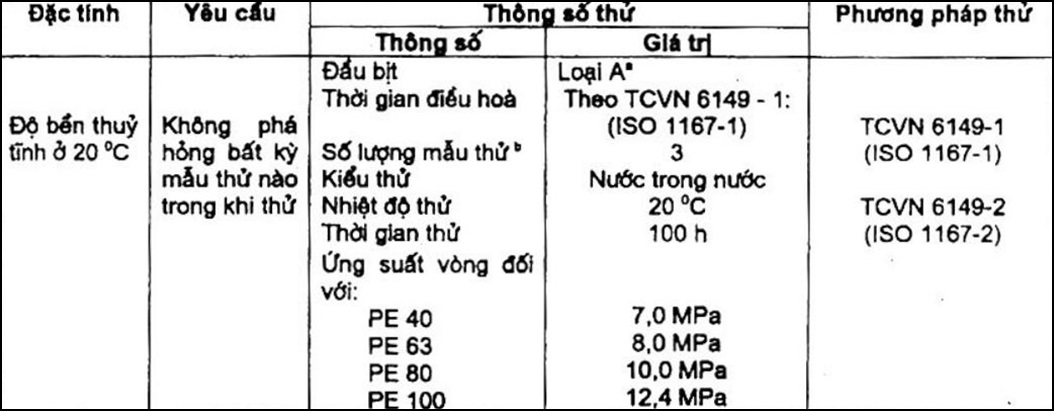
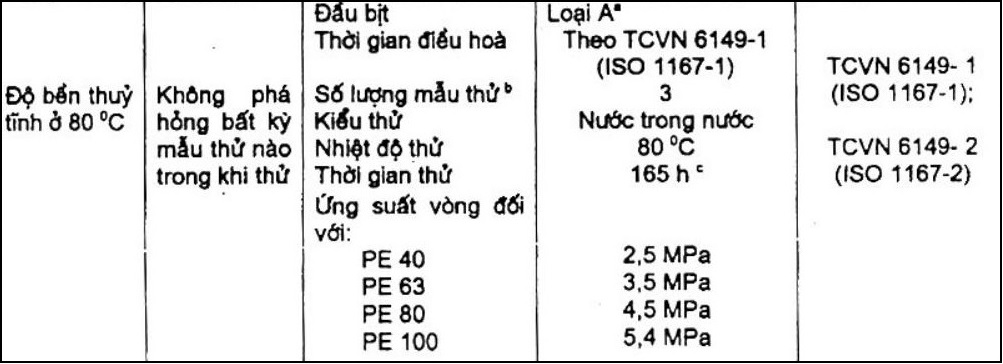
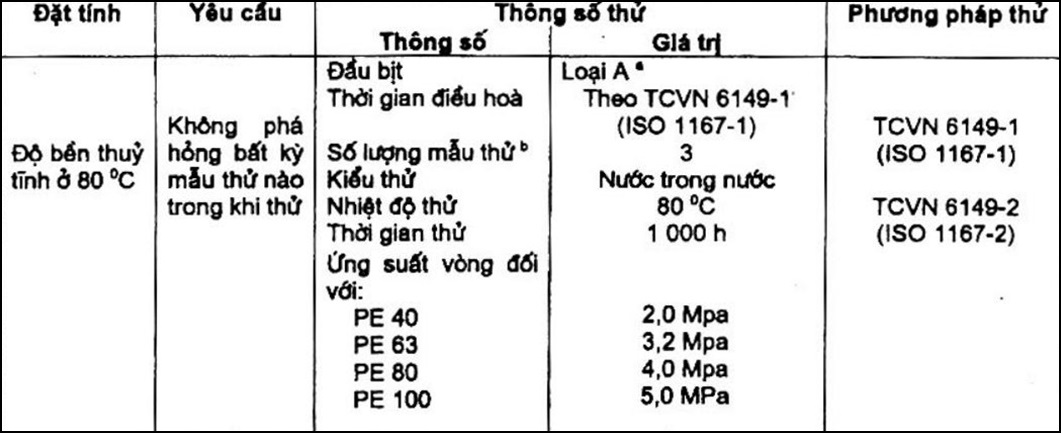
Example: PE 80 pipe; DN 110 × 15.1 mm; SDR 7.4; PN 20. To evaluate the hydrostatic pressure resistance of this pipe, the laboratory tests 3 pipe specimens under the 3 conditions of 20oC for 100 h; 80oC for 165 h; and 80oC for 1,000 h. The hoop stresses required by the standard in Table 3 above are the basis for the laboratory to calculate the test pressure for each condition. For PE 80, the hoop stresses for testing at 20oC for 100 h; 80oC for 165 h; and 80oC for 1,000 h are 10.0 MPa, 4.5 MPa and 4.0 MPa respectively. The test pressure is calculated with the following formula:
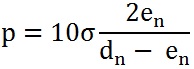
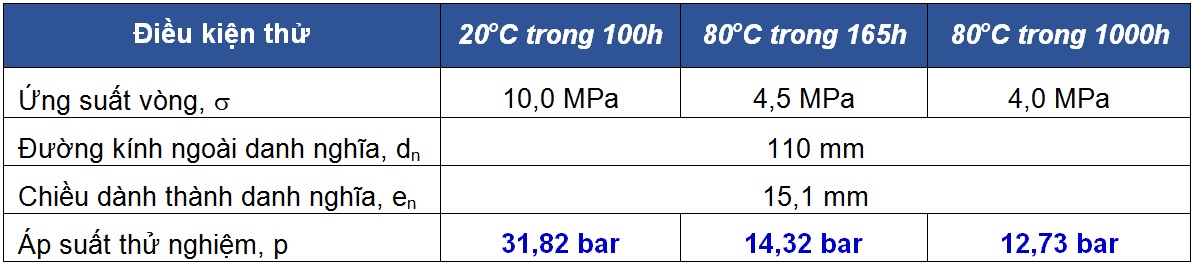
After conditioning the specimens at the test temperature (20oC or 80oC) for the period specified in TCVN 6149-1 (ISO 1167-1), each pipe specimen is subjected to a constant internal hydrostatic pressure for the specified period of 100 h, 165 h or 1,000 h, or until failure. Throughout the test, the specimens are kept in an environment at the specified constant temperature. Only if no specimen fails during the entire test is the pipe shown to meet the hydrostatic pressure resistance required by the standard for pressure class PN20 and suitable for water supply or drainage systems designed for an operating pressure of 20 bar.
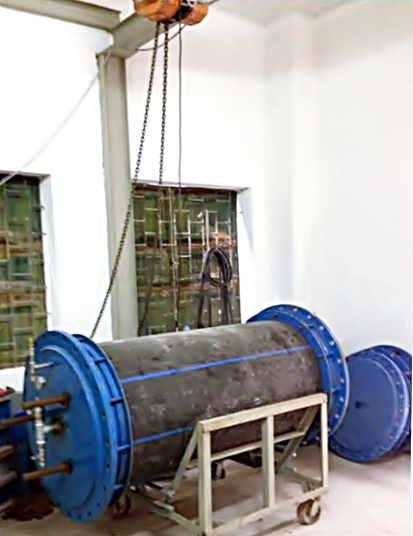
Figure 2: Pressure resistance testing of a PE100-DN800 pipe
The laboratory of the Centre for Environment and Construction Mechanics, Vietnam Institute for Building Materials, can test all mechanical, physical and chemical properties of all types of plastic pipe materials such as PVC, PP and PE, including large pipes up to 1–2 m in diameter, in accordance with standards such as TCVN, ISO, EN, DIN, BS, AS and ASTM.
REFERENCES
[1] TCVN 8491, Plastics piping systems for water supply and for buried and above-ground drainage and sewerage under pressure – Unplasticized poly(vinyl chloride) (PVC-U).
[2] TCVN 7305, Plastics piping systems – Polyethylene (PE) pipes and fittings for water supply.
[3] TCVN 10097, Plastics piping systems for hot and cold water installations – Polypropylene (PP).
[4] TCVN 6149, Thermoplastics pipes, fittings and assemblies for the conveyance of fluids – Determination of the resistance to internal pressure.
[5] TCVN 7298:2003 (ISO 497:1973), Guide to the choice of series of preferred numbers and of series containing more rounded values of preferred numbers.
[6] ISO 9080:2003 Plastics piping and ducting systems – Determination of the long-term hydrostatic strength of thermoplastics materials in pipe form by extrapolation.
For nominal pressure class testing of pressure plastic pipes, please contact
Centre for Environment and Construction Mechanics – Vietnam Institute for Building Materials
Address: Lane 235 Nguyen Trai Street – Khuong Dinh – Hanoi, Vietnam
Tel: +84 24 3558 5928; +84 915 502 834; +84 912 181 479
Website: http://vibm.vn;
Email: thietbimoitruong.vibm@gmail.com ; tamnt.tbmt@gmail.com
Information Centre