VIBM: Sound Insulation Testing of Buildings and Building Elements
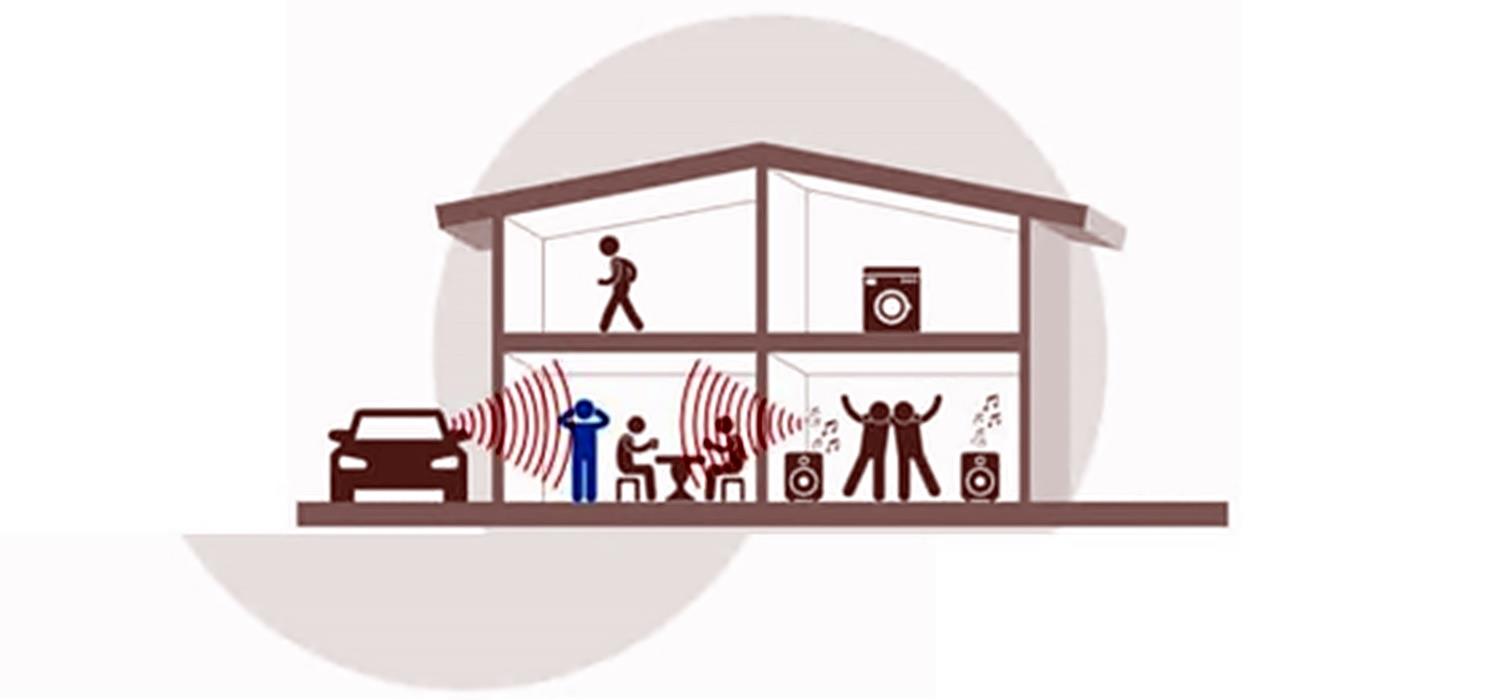

Noise pollution is invisible but always present around us, affecting the health and well-being of millions of people every day. Sound insulation and noise control, especially in large cities, have therefore recently attracted attention not only worldwide but also in Vietnam. The authorities have issued many regulations on noise control to protect public health, most notably Decree 45/2022/ND-CP, the latest regulation on administrative penalties in environmental protection, which sets very high fines for violations of noise regulations. Research and development of sound insulation testing for building materials and structures in Vietnam is therefore of urgent scientific and practical importance and contributes to protecting public health and socio-economic development.
Building acoustics concerns the propagation of sound within a building, between enclosed spaces, from outside to inside and even from inside to outside. The field also covers preventing the propagation of noise to avoid acoustic disturbance, which can cause many health problems. Noise is unwanted sound that is annoying, disturbing or harmful to the health of those who perceive it. It causes discomfort and interferes with attention, communication, concentration and rest, and affects sleep. Prolonged continuous noise can cause chronic stress, leading to psychological and physical disorders, cardiovascular disease and changes in the immune system.
According to some studies, noise of 30 dB or more can cause sleep problems such as sleep disruption and insomnia to varying degrees depending on the individual. Everyone’s home should be a noise-free space for sleep and rest. The direct consequence of inadequate rest is that those affected cannot concentrate properly on their work the next day. This is clearly reflected in lower academic performance or labour productivity, more workplace or traffic accidents, and anti-social behaviour.
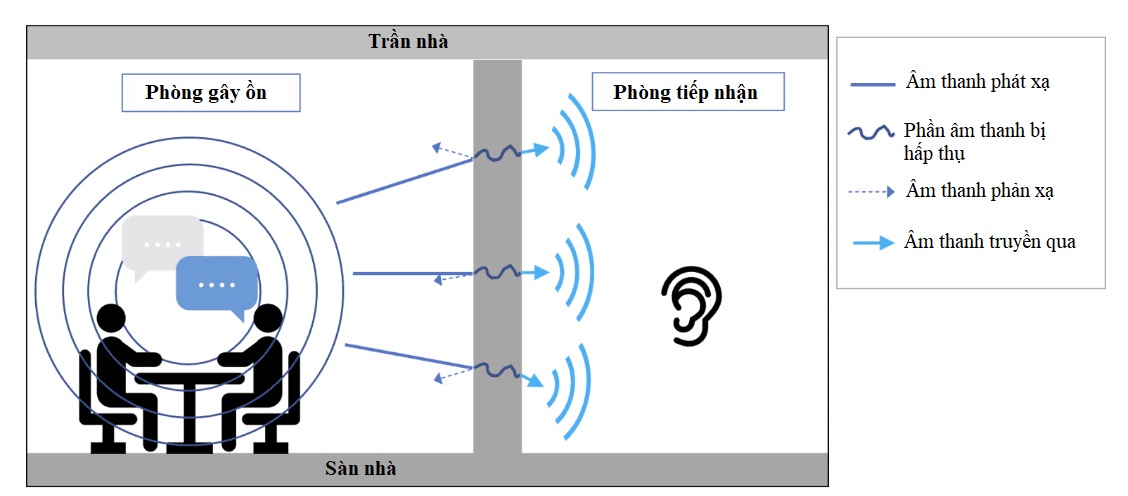
There are two main types of noise pollution: airborne noise (Airborne Noise) and impact noise (Impact Noise). Airborne noise consists of sound waves travelling through the air from the source to our ears. It includes most typical forms of noise pollution, such as television, music, conversation and outdoor traffic. Airborne noise can still pass through a surface (such as a floor or ceiling), but the sound is more attenuated on the other side, because sound waves lose energy when passing through the surface, while part of it may also be absorbed or reflected.
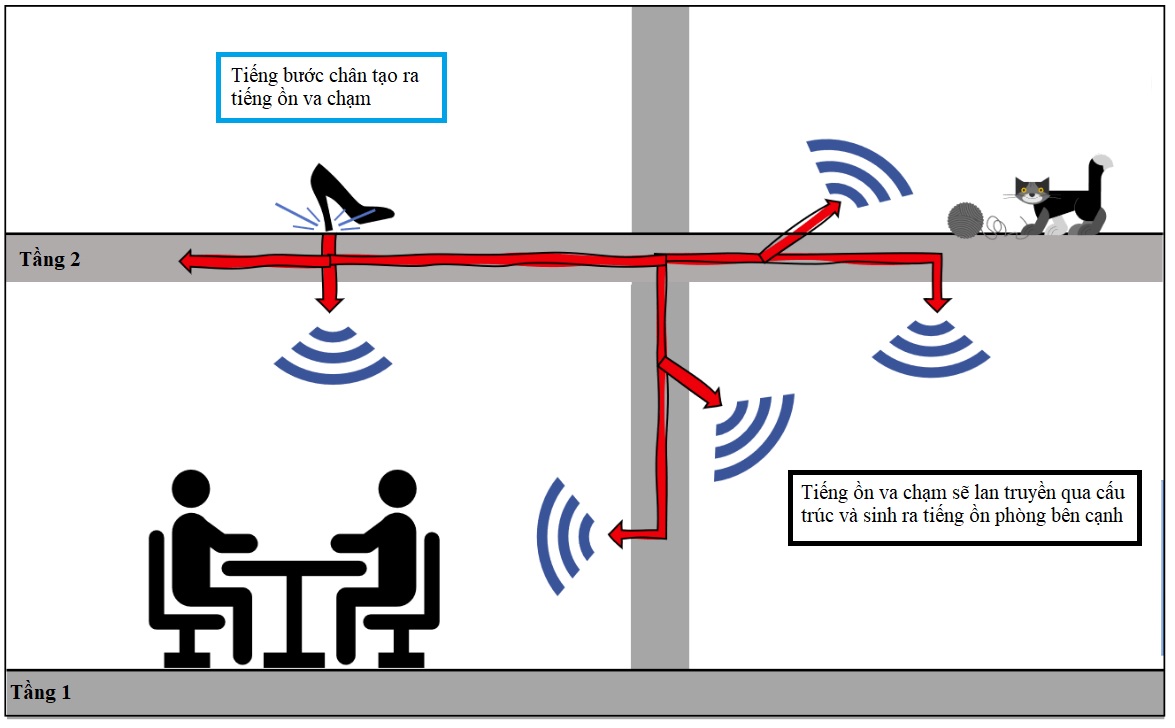
Impact noise is sound generated by direct contact between an object and a surface, such as footsteps, moving furniture or dropping something on the floor. Impact noise – also called structure-borne noise (structure-borne noise) – is caused by vibration: an object strikes a surface and creates vibrations that travel through the structure and emerge on the other side as sound waves. Impact noise is considered harder to control than airborne noise because it carries more vibrational energy, but it can still be blocked or reduced. The “mass law” in acoustics is the basis of airborne sound insulation: the denser a material, the harder it is to set it vibrating with sound waves. Sound transmission through the material is therefore strongly attenuated and insulation improves, whereas good sound-absorbing materials are light and porous and unsuitable for sound insulation. Noise pollution is therefore increasing as modern buildings tend to replace heavier materials with lighter ones.
| a. Airborne noise | b. Impact noise |
Figure 2: The two main types of noise pollution in buildings
There are four main principles for preventing noise from entering a space: blocking, damping, decoupling and absorption. Each has a different effect on sound insulation and is useful in different situations:
Sound blocking (Sound Blocking): adding mass to a structure makes it harder to vibrate, so airborne sound waves are attenuated as they pass through it. However, heavy materials are not effective against impact noise. Heavy materials act as a sound barrier against airborne noise; thicker, heavier materials block sound better. The rule is that doubling the mass reduces sound by 6 dB. For example, if a 150 mm concrete slab blocks 51 dB, a 300 mm slab will block 57 dB.
Sound damping (Sound Damping): damping prevents vibrations in the structure from forming sound waves. One of the most common damping materials is viscoelastic compound, which never fully hardens and therefore converts vibrations into heat rather than transmitting them. It is very effective against both impact and airborne noise, and also works well to reduce low-frequency or construction noise.
Sound decoupling (Sound Decoupling): Decoupling is the most effective noise control principle. Also called mechanical isolation, it involves interrupting the path of sound waves through mechanical connections (such as wall studs). Decoupling is another form of blocking, as it physically prevents sound waves from travelling through the structure. There are various ways to decouple walls, such as building two separate stud frames and filling the cavity with sound insulation, but this requires considerable construction work. A more common method uses resilient channels and sound isolation clips, which separate the plasterboard from the studs so that sound waves cannot travel easily. Decoupling is effective against impact noise, and because it adds layers to the structure it is also effective against airborne noise.
Sound absorption (Sound Absorption): sound-absorbing materials convert sound waves into heat, reducing their amplitude (volume). Absorption does not block sound; it reduces it, so it can be regarded as sound management rather than sound blocking. These materials are commonly used to control echo and reverberation to improve sound quality in a space. Typical sound-absorbing materials are porous (open-structured), allowing sound waves to enter and lose energy as they try to vibrate the fibres of the material. Eventually the sound wave loses part of its energy as it is converted into heat, which is regarded as absorption. Absorption therefore contributes to sound insulation, but unlike the other three principles: absorption manages sound, while the other three block it. Although absorption does not block sound waves, it is still useful in a sound insulation project – for example, if sound waves can be absorbed, fewer will pass through the structure. But a wall made only of absorbing material will still transmit sound, since its porous nature does not stop noise. Effective noise control relies on combining these four principles to varying degrees.
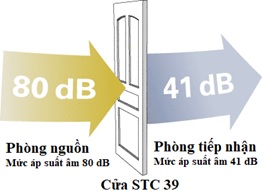
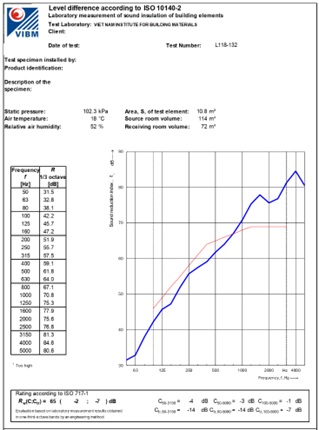
The noise reduction capability of a building element (e.g. walls, ceilings, doors and windows) is called the sound transmission loss (sound transmission loss – TL) or sound reduction index (sound reduction index – R). These indices are values in decibels, determined by measuring the sound pressure level in one-third-octave bands from 125 Hz to 4,000 Hz in the source room and the receiving room. The calculation also accounts for the area of the partition between the two rooms and the acoustic correction for the receiving room (reverberation time).
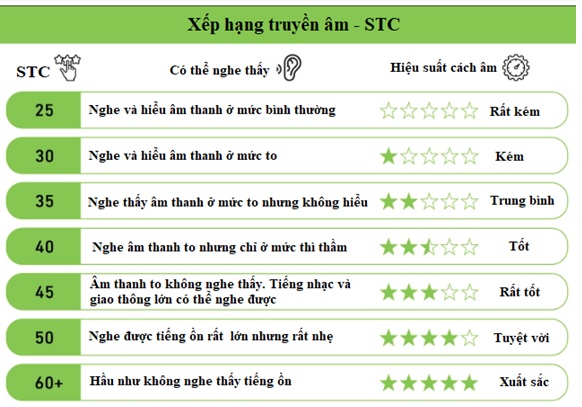
The difference between the two corrected sound pressure levels is the TL of the product; the higher the TL, the better. TL is measured over a range of frequencies, which makes it difficult to compare different products. The Sound Transmission Class in the ASTM system (Sound Transmission Class – STC) or the weighted sound reduction index Rw in the ISO system solves this by giving a single value for a product’s sound transmission performance. STC is determined from the weighted TL values over 16 frequencies, by shifting a reference curve in 1 dB steps towards the measured curve using the method specified in rating standards such as ASTM E413 or ISO 717-1 (TCVN 7192-1). The higher the STC, the better the rating and the sound insulation performance.
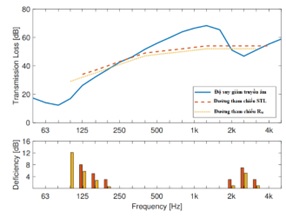
The procedures for rating airborne sound insulation using STC and the weighted sound reduction index Rw are essentially the same. In both systems, the calculation uses a reference curve, shown in Figure 3. The ASTM reference curve has the same shape as the ISO curve but uses a slightly different set of frequency bands.
Figure 3: Reference curves for calculating STC and Rw
The ISO procedure described in ISO 717-1 (TCVN 7192-1) for determining the Rw rating is as follows:
1. The sound reduction index R is rounded to 0.1 dB.
2. The reference curve (100 Hz to 3,150 Hz) is shifted in 1 dB increments; the positive differences between the reference curve and the sound reduction index are called unfavourable deviations.
3. Step 2 is repeated until the sum of the deviations does not exceed 32 dB.
4. Rw is the value of the shifted reference curve at 500 Hz.
5. Additional spectrum adaptation terms (such as C and Ctr) can be calculated for different frequency ranges, e.g. for low-frequency spectrum adaptation.
The ASTM procedure described in ASTM E413 for determining the STC rating is as follows:
1. The transmission loss TL is rounded to the nearest 1 dB.
2. The reference curve (125 Hz to 4,000 Hz) is shifted in 1 dB increments; the positive differences between the reference curve and the transmission loss are called deficiencies.
3. Step 2 is repeated until the sum of the deficiencies does not exceed 32 dB and the deficiency in any single band does not exceed 8 dB.
4. The STC rating is the value of the shifted reference curve at 500 Hz.
5. There are no additional spectrum adaptation terms for the STC rating.
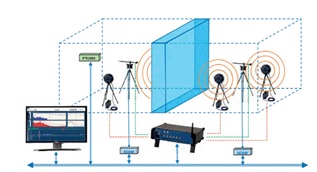
The sound reduction index or sound transmission loss is the parameter describing a product’s sound insulation performance, usually determined in the laboratory or in the field. The theoretical formula for the transmission loss of a partition between two rooms was presented in the 1920s by Davis and Buckingham, and the first ASTM standard was based on London’s proposal in 1951. The principle of the method has remained unchanged over the years. Current test standards include ISO 717 (TCVN 7192), ISO 10140, DIN 52210 and ASTM E90; the pressure method is also called the conventional or two-room method.
Lp1 and Lp2 are the time- and space-averaged sound pressure levels in the source and receiving rooms; S (m2) is the area of the test specimen; A (m2) is the equivalent absorption area of the receiving room – i.e. the sound reduction index is determined indirectly from the average sound levels of adjacent test rooms. The sound reduction index is usually determined in one-third-octave bands over at least 100–3,150 Hz, or as the weighted sound reduction index Rw, determined in accordance with TCVN 7192 (ISO 717).
Figure 4: Laboratory set-up for determining the sound reduction index
Centre for Environment and Construction Mechanics – VIBM is one of the leading units in research and testing, building acoustics assessment, simulation of the sound insulation of building elements, and field sound insulation assessment in accordance with national and international standards such as TCVN 7192 (ISO 717), ISO 140, ISO 16283, ISO 10140, ASTM E336, ASTM E90, ASTM E413, ASTM E1007, ASTM E492 and ASTM E989.
Contact details
Centre for Environment and Construction Mechanics – VIBM
Address: Lane 235 Nguyen Trai Street – Khuong Dinh – Hanoi, Vietnam
Tel: +84 24 3558 5928; +84 915 502 834; +84 912 181 479; Fax: +84 24 3858 1112;
Email: tbmt.atld@gmail.com
Website: vibm.vn